
A unique structure in Juktan
In the late 1970s, the Juktan pumped-storage power station in northern Sweden was inaugurated. In its own way, it was just as groundbreaking as the pioneering hydropower plants in Trollhättan, Porjus and Älvkarleby. Using a unique design, water was pumped hundreds of metres up through Blaikfjället in Storuman/Sorsele municipality when electricity prices were low and released down to the turbines when prices were higher. Due to changing circumstances, the pumped-storage power station was decommissioned in the late 1990s, but it may now be restored to its former glory.
By the end of the 1960s, it was no longer possible to develop or regulate any more rivers. Four rivers – the Torne, Kalix, Pite and Vindel – had been protected for environmental reasons. If further hydropower were to be developed, the only options left were undeveloped stretches of rapids in rivers that were already regulated, or smaller watercourses.
One such smaller watercourse was the Juktån, a tributary of the River Ume. Lake Storjuktan had been regulated since the early 1960s, and between this lake and the river’s confluence with the River Ume lay an undeveloped stretch of rapids with a total head of 140 metres. However, harnessing the power in a conventional manner would not be sufficiently efficient. Vattenfall studied various alternatives and settled on something considerably more unconventional.
Efficient pumped storage
Between Storjuktan and Storuman – a lake outlet into the River Ume – lay Blaikfjället mountain, a rocky plateau situated just over 200 metres higher than Storjuktan. On the plateau were a number of small lakes, including Lake Blaiksjön, which could be used as reservoirs. Vattenfall then began to investigate the feasibility of constructing a pumped-storage power station beneath Blaikfjället.
A pumped-storage power station is used to generate energy in the same way as a conventional hydroelectric power station. However, a pumped-storage power station must have at least two reservoirs at different elevations. One reservoir is situated at a lower level, and from there water is pumped up to a reservoir situated at a considerably higher level. Pumping takes place at times of low electricity demand – that is, when electricity prices are lower. The water from the higher-level reservoir is released when energy demand is greater and the price is higher.
Pumped-storage power stations were not, in themselves, a new concept. As early as the beginning of the 1930s, Vattenfall had built a pumped-storage power station at Sillre, a tributary of the Indalsälven. But what was now being planned was on a completely different scale. It was to be one of the largest in the world at that time.
The construction of the pumped-storage power station proved to be a major challenge, as it required extensive rock excavation work. Horizontal tunnels totalling almost twenty kilometers were drilled beneath Blaikfjället. Construction work began in the summer of 1973, and at its peak the workforce numbered around 500 people. A temporary housing estate was built for the staff by Lake Blaiksjön.
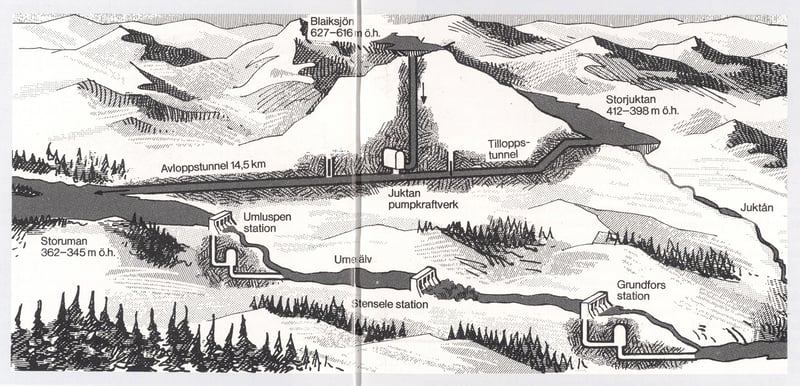
Through the long tunnels, water from Storjuktan could be pumped up to Lake Blaiksjön, before being released back down through the turbine and on to Storuman. Image from the book ‘Juktan – pumpkraftverket som gjort sitt’.
Storjuktan served as a reservoir at the lower level. From there, the water was channelled via a canal to a 5.2-kilometre-long tunnel – with a cross-sectional area of 60 square metres. The tunnel led to a power station situated 250 metres down into the rock. From there, water was pumped up to Lake Blaiksjön, which served as the upper reservoir. When required, the water was released from the lake down the same route. Adjacent to the powerhouse were valves for opening and closing the water flow, as well as turbines and generators. The maximum turbine output was 335 MW. After the powerhouse, the water was then channelled through a 14.5-kilometre-long tunnel – with a cross-sectional area of 80 square metres – and a 700-metre-long discharge channel out into Storuman. This created a head of approximately 275 metres.
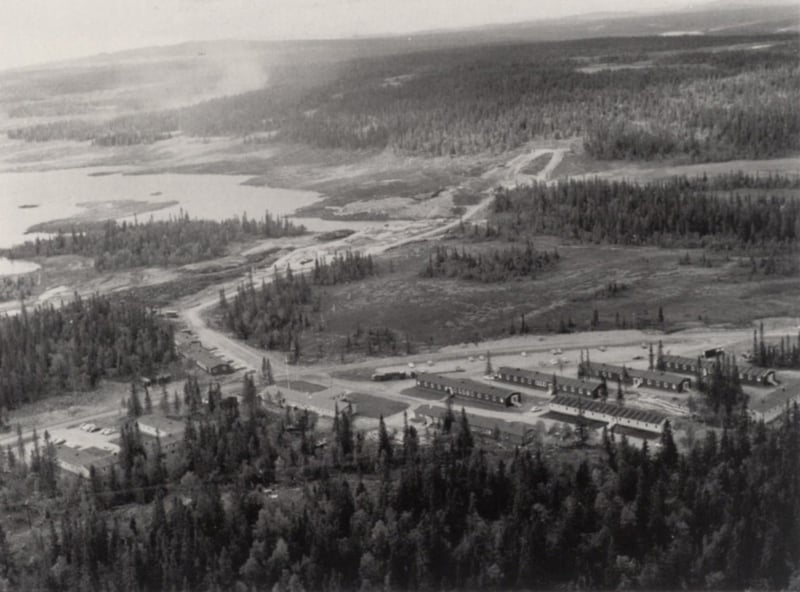
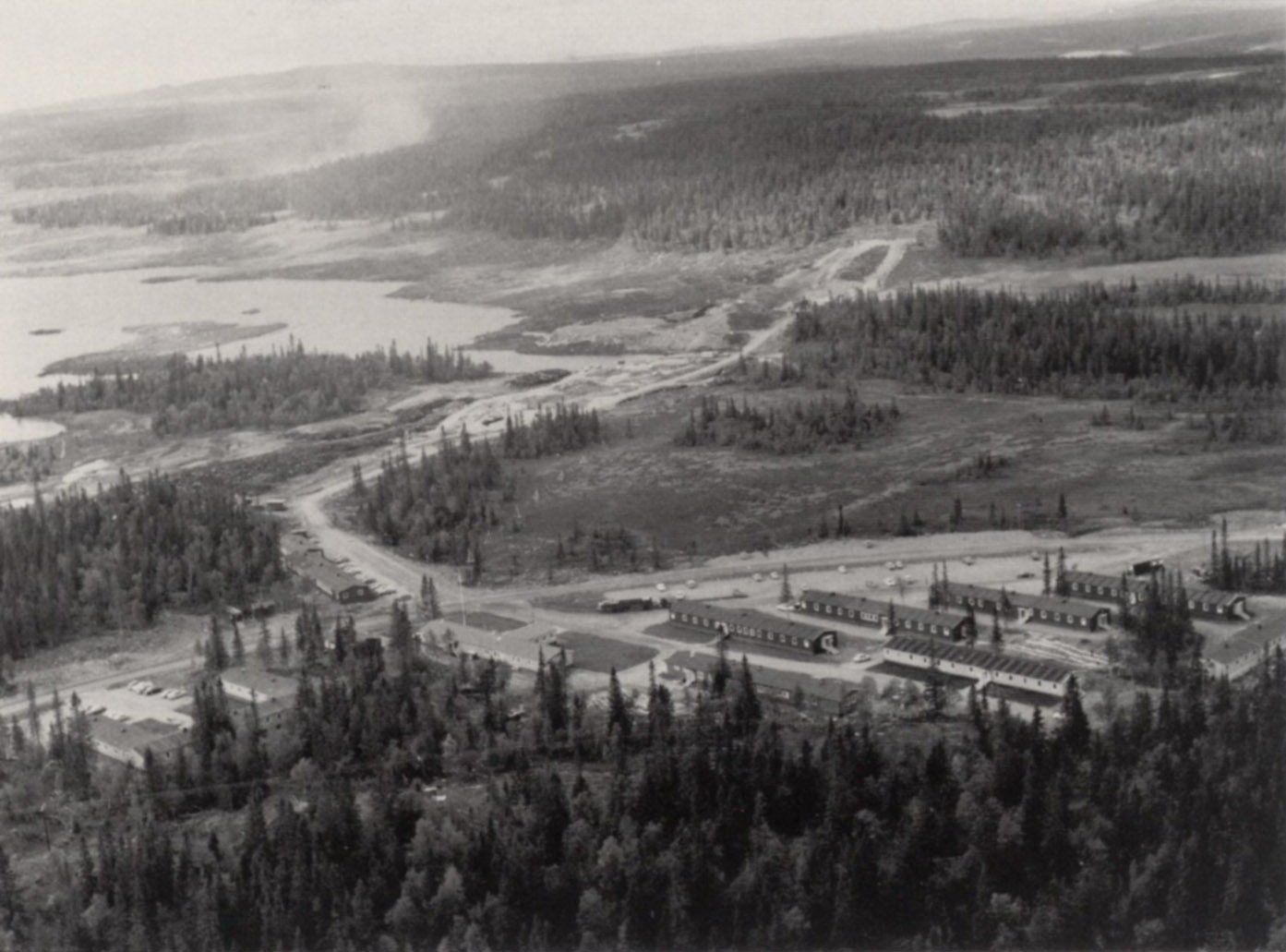
A temporary housing estate was built by Lake Blaiksjön for the construction of the Juktan pumped-storage power station. From the book ‘Juktan - pumpkraftverket som gjort sitt’.
Many challenges
The construction of the tunnels proved more complicated than anticipated due to the varying quality of the rock, and the work was delayed by several months. Rigorous safety systems and safety checks were also required for such a sensitive facility.
None of the standard valve types had been tested for such large dimensions and such high pressure. Together with the engineering firm KMW in Karlstad, Vattenfall succeeded in developing a ball valve capable of withstanding the most extreme scenarios, not least to protect staff, as the facility could otherwise have been flooded in just a few minutes.
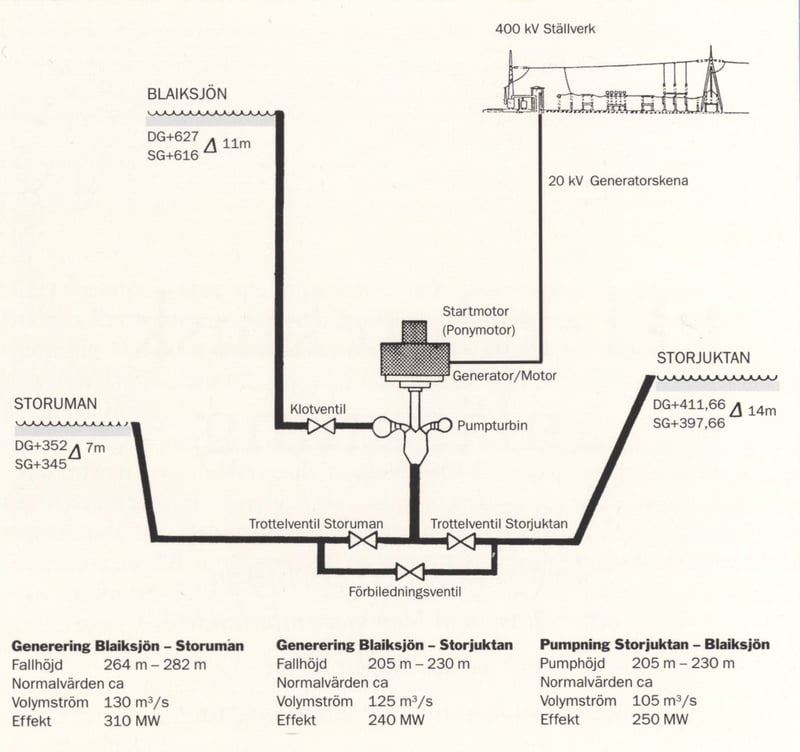
An overview of the differences in elevation at the Juktan pumped-storage power station and the surrounding lakes. From the book ‘Juktan - pumpkraftverket som gjort sitt’.
The machine room – which was located 250 metres underground – was housed in a rock cavern 39 metres long and 20.3 metres wide. The route down to the machine hall ran through a very steep road tunnel. The premises and control equipment were housed in a two-storey concrete building in a rock cavern running parallel to the machine hall. That building contained staff facilities and storerooms. The generator substation was situated in another rock cavern at right angles to the machine hall and connected to an electrical and control building. The connection between the generator and the switchyard above ground was made via a 280-metre-long shaft. This solution was previously untried, and presented many technical and installation challenges, which Vattenfall was able to resolve in collaboration with the French company Simelectro.
The control centre was equipped with a wide range of control and monitoring functions in addition to those found in a standard power station. By this time, programmable microcomputers had also begun to be developed, and these proved to be suitable tools for the plant’s control systems and processes. For this purpose, a computer developed by Asea (now ABB) was installed. The station thus became a gateway to the wider use of computer-based process control in hydroelectric power stations.
Once all the checks had been completed, the Juktan power station was commissioned in November 1978. The commissioning manager, Gustaf Funegård, and the works manager, Olle Gellertsted, then composed the following lines for Director-General Jonas Norrby:
The reversible turbine at Juktan
was started up for the first time
on Vendela Day, 8 November 1978
The Director-General replied in the same vein:
Vendela was a fitting name
it’s good that Juktan is up and running
thank you for your fine efforts
(Unfortunately, the wordplay on the name Vendela does not translate into English.)
Despite all the checks and safety measures, it was not possible to prevent every incident. During a test in March 1979, whilst the machine was running at full speed, one of the metal straps came loose and caused a short circuit. Thankfully, this happened during a meal break and no one was near the unit.
The technology spread
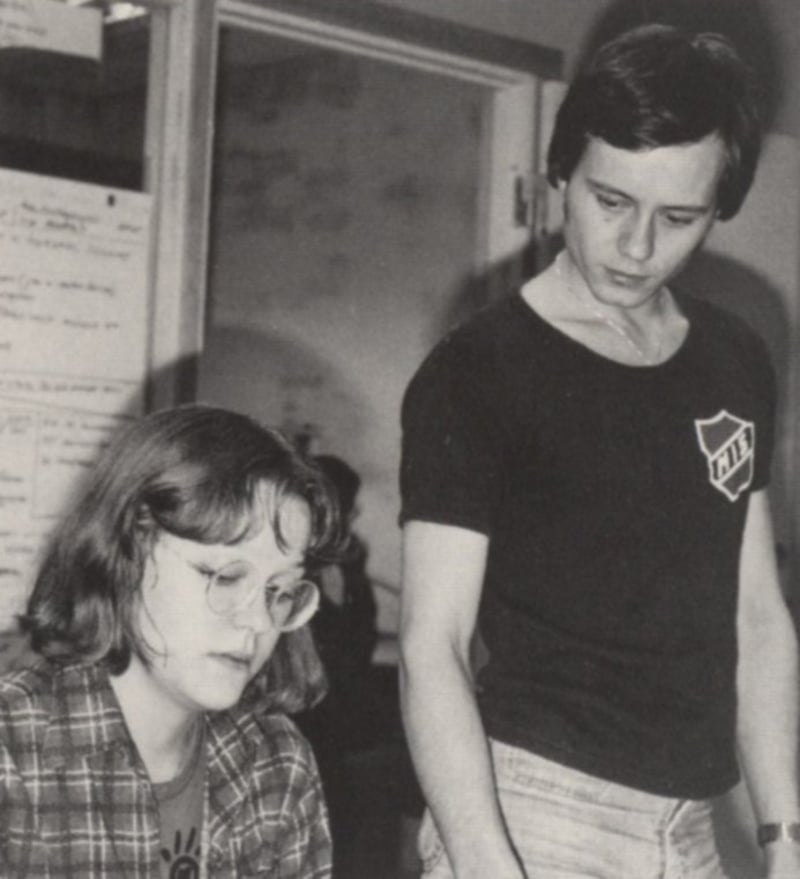
Elenor Båtsman and Ronny Blomfeldt. Elenor was one of two female production engineers at Vattenfall in the late 1970s and worked at Juktan.
Juktan became an exceptional training ground for young engineers. One of them was Elenor Båtsman, one of two female production engineers at Vattenfall at that time. The other was her twin sister Lisen, who worked at Vattenfall’s operations centre in Vuollerim. Elenor Båtsman continued to work at Vattenfall until her retirement in 2019.
The technology that Vattenfall developed while working on the Juktan power station was also shared with others. At a UN symposium in Athens in the autumn of 1979, Vattenfall presented the detailed report ‘Juktan – A pumped storage plant using three reservoirs’, which was met with great interest.
Following the deregulation of the Swedish electricity market in the early 1990s, it was no longer profitable to operate Juktan as a pumped-storage power station. It was therefore converted into a conventional power station, with water being channelled from Storjuktan through the converted turbine and on to Storuman. The converted power station came into operation on 30 November 1996.
Since then, conditions have changed again, as demand for fossil-free electricity is expected to rise sharply. Consequently, in 2023, Vattenfall decided to carry out preliminary design work to once again use Juktan as a pumped-storage power station. This ‘reclaimed’ pumped-storage power station could come into operation in the mid 2030s, at which point it will have a maximum output of 320 MW.
As part of the design work, Vattenfall has used drone technology to laser-scan the entire facility and build a digital replica of it. Read more about this work on Vattenfall’s corporate website.
Due to the green transition, pumped-storage power stations have become more attractive options internationally as well. In November 2020, the International Hydropower Association (IHA), together with the US Department of Energy, launched the International Forum on Pumped Storage Hydropower. This forum brings together governments, industry, financial institutions, academia and non-governmental organisations to share their experiences and develop guidance and recommendations on pumped storage power stations.
Interesting fact:
A large number of compressors were required to supply the compressed air needed for the construction work. Once the work was complete, Vattenfall donated the compressors and pipework to Tärnaby, enabling the town to acquire snow cannons for the Ingemarsbacken ski slope, named after Swedish 1980s skiing star Ingemar Stenmark. Tärnaby thus became one of the first towns in Norrland to have a snow cannon. One of the driving forces behind the ski slope was a former Vattenfall employee.
See also

Vattenfall's investments 2000–2016. From fossil fuel to wind
In the early 2000s, clear signals were being received from political quarters that renewable energy was on the agenda. However, it took time for Vattenfall to shift from investment plans dom...

The history of district heating
The argument for district heating is as strong today as it was in the 1960s. Good for the environment, flexible and adaptable, convenient and with high security of supply.

Logotypes now and in the past
From classic symbols to modern expressions – Vattenfall's logotype has reflected the spirit of the times for over a century.